The preferred method of submission is at the conference on diskette together with the hard copy.
Each author should submit all source files (text and figures) needed to make the paper (see below), the postscript version, a hard copy of the paper and complete the Paper Submission Sheet containing additional information described below.
Contributed papers may be up to 3 pages long and invited papers up to 5 pages. Since the proceedings will also be published in paper form, it is necessary to maintain these limits.
Authors are advised to use the templates and in case of difficulties they should consult the EPAC electronic publication help pages
See the sample paper for a typical implementation of the requirements.
Manuscripts should be prepared for one side of the paper and have:
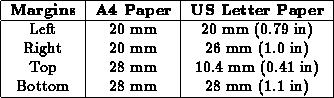
The margins should be as follows:
In order to be compatible with the Adobe Acrobat Distiller, use only TIMES (in roman, bold or italic), symbol and Zapf Dingbats. Please note that Times New Roman is different and IS NOT ACCEPTABLE.
All contributions should use 10pt fonts for the normal text.
The title should use 14pt bold uppercase letters and be centred on the page.
The names of the authors and their organisation/affiliation and mailing address should be in 12pt upper and lower case letters.
Section headings should numbered, use 12pt bold uppercase letters and be centred in the column.
Subsection headings should numbered (e.g. 3.2 Penalties for Late Submission), have 12pt italic letters and be left aligned and justified in the column.
Place figures and tables as close to the place of their mention as possible. Lettering in figures and tables should be large enough to reproduce clearly,using only the approved fonts.
All figures and tables must be given sequential numbers (1, 2, 3, etc.) and have a caption placed below the figure or above the table being described.
All bibliographical references should be numbered and listed at the end of the paper in a section called ``REFERENCES''. When referring to a reference in the text, place the corresponding reference number in square brackets. See the sample paper for typical examples.
The following distinctions may not be particularly clear when viewed with web browsers but are quite significant on electronic and paper proceedings.
Care should be taken to distinguish mathematical symbols from the abbreviations for the names of physical units. For example, in
the
`s'
(in the ordinary roman font), which stands for the unit of time,
is clearly distinguished from the variable
s.
On the other hand always enter
math-mode when mentioning symbols, like x or a,
in the text.
Similarly for the names of particles; e.g.,
an  collider
(not an
collider
(not an  collider).
Again, whenever an English word appears in a formula, even as a suffix, it should be set in TIMES roman type (as opposed to symbol or TIMES italic):
The use of the International System of Units (SI units) is advocated. Acronyms should be defined the first time they appear.
DO NOT switch on page numbers.
In order to facilitate the processing of the papers as they are received by the editors, authors are requested to supply additional information about the paper and how it was prepared together with the keywords. A Paper Submission Sheet for this purpose, pre-printed with the paper's programme code etc., is sent to authors with the final instructions. (See the example).
The information on the sheet comprises:
Templates and examples can be retrieved through Web browsers like NCSA Mosaic and Netscape by loading to disk. See your local documentation for details of how to do this.
Template documents for the recommended word processing software can also be retrieved from the ftp server (epacsrv.cern.ch (128.141.203.202)); they can be found in the directory (folder) templates and exist for LaTeX and WORD (Mac and PC) for US letter and A4 paper sizes. The file templates.txt in the same directory (folder) contains a description of the various files.
To facilitate the extra work involved in processing the electronic versions of
the papers
the deadlines for submission at the conference will follow the rhythm of
the conference.
Papers due to be presented on Monday 10th June will be accepted from Sunday p.m. until mid-day Monday, then Tuesday's papers from Monday p.m. until mid-day Tuesday and so on.
The deadline for papers submitted by ftp is midnight on Sunday 2nd June.
This is earlier so that problems with the paper can be discussed with authors at the
conference.
The preferred method of submission is at the conference on diskette together with the hard copy. The following steps are necessary:
If you cannot do this, then create an additional plain text (ASCII)
file (extension .txt) containing
the additional information described above and
submit all of the files by ftp in the following way:

